
About us
At the Professional Record Standards Body (PRSB), we work to ensure that health and care professionals have the right information at the right time to support the people they care for.
We do this by developing national standards for health and care records, working closely with people who use services, clinicians, and the teams who design and build digital systems. Our clear, consistent standards help information flow safely across services, supporting better care, safer decisions, and more joined-up services for everyone.
We are an independent, not for profit, community interest company.
We uniquely represent clinical, social care and people.
We are UK-wide, developing health and care standards across the four nations.
Our standards identify the critical set of information needed for safe and high quality care.
We support implementation of standards, helping health and care staff embed standards into everyday practice.
Our goal is that people will only have to share information once, and their records will be available in every care setting including at home.
FAQs
Our standards exist to improve the safety and quality of health and social care, ensuring the right information about a person receiving treatement can be accessed easily by any authorised health and care professional who needs it.
Using digital care records, built on the same standards, means that the information recorded about a person can be shared whenever and wherever appropriate.
PRSB standards are made up of sections such as diagnoses, medications and allergies and a description of the information that should be recorded under each of these sections. These standards are intended for use by all health and care organisations.
PRSB standards aim to provide a common language for health and social care so that we can ‘bridge the gap’ and provide truly integrated care with information flowing in real time between health and care staff and systems.
We are a member organisation made up of health and care professional bodies and patient representative groups. We also work closely with people who have used services and systems experts and suppliers. Our work is commissioned by different bodies, including NHS England.
PRSB has developed a wide range of different standards and guidance for use in clinical and care settings. PRSB standards are published on our website and set out the detailed information models for each standard and the guidance that explains how to implement them in IT systems and use them in clinical and professional practice.
People who use services will only have to share information once, and their records will be available in every care setting including at home. In addition to helping professionals to provide safe and effective care, it also means that people have access to their own records and can take greater control of their care.
The information collected from people can also be used to make care better for the future through audit of existing treatments and services, improving the quality of care and research so we know more about illnesses and develop new and better treatments and care options.
How we develop standards
Our work is driven by our membership and by our involvement with public and patient bodies. All our members understand the critical importance of high quality care records and we work together on standard development projects.
Our work is evidence based and developed through consultation with our members and other relevant stakeholders, focusing on frontline staff and people who use services.
We agree together what information should be recorded at each stage of a person’s treatment and care. Health and care IT systems can use our standards to enable timely information sharing across multiple services and care settings.
Find out more
- Standards explained
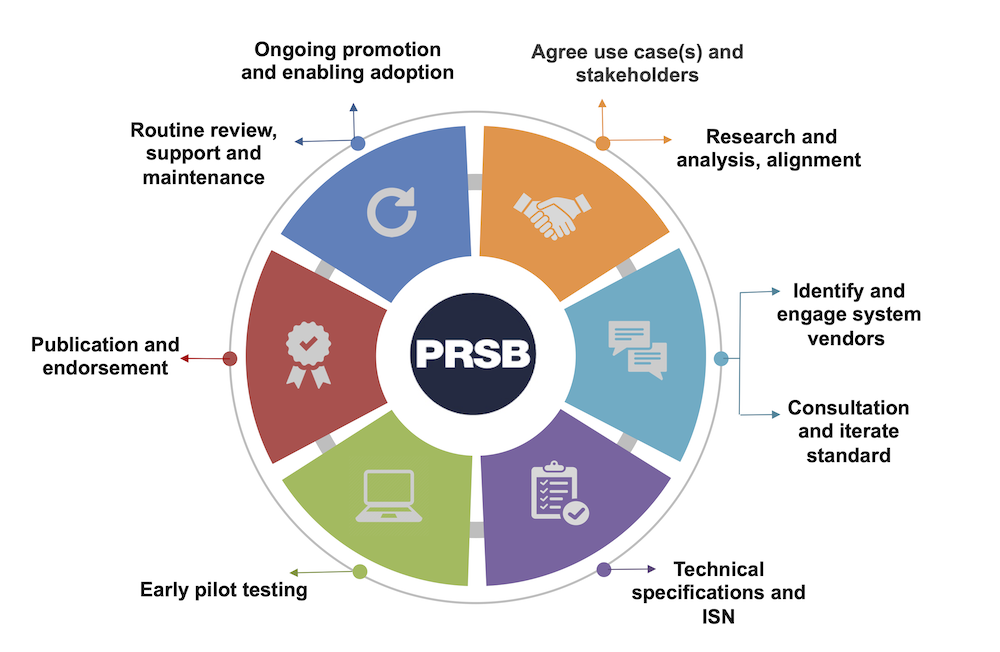
PRSB’s guide to standards which sets out the purpose and benefits of using standards and how to support frontline professionals to adopt them. - The standards methodology life cycle
Get involved
We work with health and care professionals, system suppliers, carers and people. We give all our stakeholders an equal voice, actively engaging with our network to identify, develop and support the implementation of standards. Here are some ways you or your organisation can work with us to help us achieve our goals.

Contribute to standards development
Consultation is critical to our work so we can ensure the right information is captured and shared across all of our standards. You can contribute to standards development by attending a webinar or completing a survey for a new standard. Find out more about our open consultations by viewing our current standards in development.

Join our Standards Partnership Scheme
Join us as a PRSB partner and demonstrate your commitment to standards and their implementation. Our Standards Partnership Scheme offers services to suppliers and providers who wish to receive support on getting their systems ready for implementing our standards.
Find out more.

Represent a member organisation on our advisory board
A crucial part of our work is to make sure we bring the right people together – clinicians, social care workers, patients and the public across all four nations. We would like to hear from your organisation if you have an interest in supporting our work and joining our active member advisory board which meets every two months.