Spotlight on: Dr Steve Bentley, Clinical Lead at PRSB
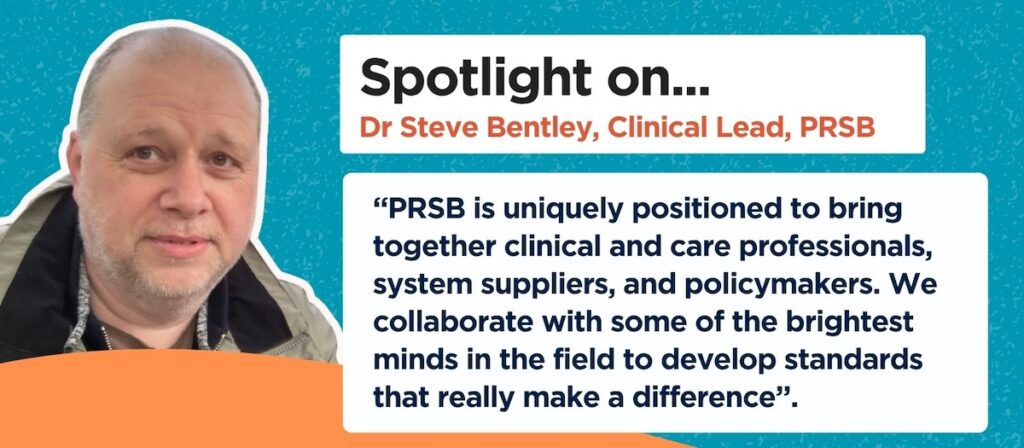
This month, we spoke to Dr Steve Bentley, a recently retired GP with a long-standing passion for improving patient care through better use of technology. As a Clinical Lead at PRSB, Steve brings valuable expertise in health informatics and SNOMED CT, along with a problem-solving mindset shaped by years of hands-on experience.   What initially […]

PRSB backs national call for standardised electronic health records in eye care

eye care

PRSB has joined a coalition of leading organisations calling for urgent national standardisation of electronic health records (EHRs) in eye care. A new position statement published by The Royal College of Ophthalmologists emphasises that standardised EHRs are essential for delivering safe, effective, and coordinated care in eye health. The statement highlights the current fragmentation of […]

Members’ reflections on the 10-year plan: Opportunities, priorities, and the role of PRSB

  As the health and care sector moves towards a more data-driven future, our members have shared their perspectives on the recently published 10-year plan. Their feedback highlights key opportunities, current successes to build on, and crucial priorities to ensure meaningful progress. Here is a summary of the key themes raised:   Unlocking opportunities through […]

A warm welcome to our new partner CareApps!

Partner welcome CareApps

  We’re delighted to welcome CareApps as a new PRSB partner and look forward to working with their team on standards conformance for their software platform, Empathika. We spoke with them to learn more about their goals and what they hope to achieve through the partnership.   Can you tell us a bit about your […]

CHAT theory also explicitly addresses five areas which if addressed systematically will help overcome stakeholder differences in pursuit of the common goal:

1. Understanding the artefacts that characterise the group and its activity.
• The artefacts might be clinical settings or the forms and templates used to capture and share information. During the pilot we heard about hard copy Dialog response forms; locally generated templates for collating information from different systems; letters and emails to GPs; images, poems or other non-text artefacts that service users might want to include in their ‘about me’ or care plan.

2. Understanding the multi-views of the group. Such groups are always a community of multiple points of view, traditions and interests. 
• Different participants in the group will have different roles and will bring to the group and their roles their own histories, language, and ‘rules’. During our Stocktake preparations and workshops we worked with psychiatrists, mental health nurses, occupational therapists, social workers, transformation leads and voluntary sector representatives, all professions and interests with their own language, approaches professional ‘rules’ but united in their interest in care plans, care planning.

3. Activity systems (like the ICSs) take shape and get transformed over periods of time. ‘Historicity’ is a term coined to express how the group’s problems and potentials can only be understood against their own history. 


• ‘We’ve always done it this way’, ‘that didn’t work before’, ‘it’s always like this’, ‘it wasn’t always like this’, ‘they are changing things again’, are all typical statements that often frustrate those charged with overseeing change initiatives. Without addressing the experiences that lie behind such comments you risk repeating mistakes of the past, alienating your stakeholders or just not understanding the real starting point for your transformation project. This is particularly the case for the implementation of the PCSP standard, the success of which will be largely reliant on point-of-care practices and information protocols as well as having systems which are user friendly and appropriately configured.

4. The central role of contradictions as sources of change and development. Contradictions are not the same as problems or conflicts. Contradictions are historically accumulating structural tensions within and between activity systems. Collectively addressing contradictions in how policy, practice, culture and technology interact will empower teams to find genuinely novel solutions for apparently intractable challenges, like interoperability and shared care plan/planning. 

This links to the fifth principle that:

5. the possibility of expansive transformations in activity systems. As the contradictions of an activity system are aggravated, some individual participants begin to question and deviate from its established norms. In some cases, this escalates into collaborative envisioning and a deliberate collective change effort. “An expansive transformation is accomplished when the object and motive of the activity are re-conceptualised to embrace a radically wider horizon of possibilities than in the previous mode of the activity.”