Smarter, safer, person-centred: CACI’s care management system meets standards conformance

CACI

We are delighted to announce that CACI is our latest Quality Partner to achieve conformance with the Personalised Care and Support Plan Standard for its Certa Care Management System. This means care providers using Certa can be confident that their system meets a nationally recognised standard for sharing digital care plans with individuals, their families, and other professionals across the care pathway, supporting a joined-up, person-centred approach. We spoke with CACI about the vision behind Certa, their experience of the PRSB conformance process, and what this achievement means for their customers.


Can you tell us what CACI is doing in the health and care sector, including your main software solutions and the benefits they provide?
CACI has supported adult social care for over 25 years. Our care software heritage includes Cygnum, an enterprise platform used by some of the UK’s largest care providers across the public, private and charitable sectors. Building on that experience, and the outcomes our customers deliver every day, we developed Certa, a SaaS (cloud based) care management solution designed for care providers of all sizes, whether that’s a growing domiciliary provider or a large multi-service organisation. Certa handles the full care management cycle: digital care planning, workforce rostering, financial management covering funder billing and payroll, and operational dashboards. Beyond the inbuilt automation features, we’re also developing AI-powered compliance features to help providers keep pace with regulatory expectations, particularly as CQC requirements around evidence and quality statements continue to evolve. More broadly, CACI supports health and social care organisations with data analytics and location intelligence tools that help with service planning and delivery.


Why have you chosen to seek conformance with the PCSP standard?
If you’re building care software around person-centred care planning, aligning with the nationally recognised standard for how that information gets recorded and shared is the obvious thing to do. The PCSP standard exists so that people receiving care don’t have to repeat themselves every time they see a new professional, and so that everyone involved in someone’s care is working from the same information. That’s what Certa was built around. It matters commercially too. Care providers, whether they’re a council commissioning services or a private care provider, increasingly want to know that their technology meets recognised standards. PRSB conformance gives them that. And as interoperability between health and social care systems becomes a bigger national priority, being conformant now puts us and our customers in a good position going forward.


How did you find the conformance assessment process?
Thorough, which is what you’d want. The PRSB assessors were knowledgeable and practical. They worked through the requirements with us in detail, reviewing how Certa captures and structures care plan information against the standard. It felt collaborative rather than bureaucratic, and the feedback was useful for further improving Certa in places we might not have spotted ourselves. It also served as a good validation exercise. We’ve designed Certa with person-centred care planning at its core from day one, and our customers helped shape a lot of that thinking through their requirements. Going through the PRSB assessment confirmed that the approach holds up against the national benchmark.


What are the benefits of this achievement for your organisation/customers?
For customers, it means they can be confident that the care plans they create in Certa meet a nationally recognised standard for quality and completeness. That matters for the people receiving care, because the information that follows them between services is structured, consistent, and is focused on them as a person. It also helps providers evidence the quality of their care records when CQC comes calling.
For us, the conformance validates the direction we’ve taken with Certa. We’re bringing on new customers from both public and private sectors at the moment, and the PRSB quality mark gives prospective buyers independent assurance that our care planning approach is sound. Certa already supports providers with inspection readiness, from pulling evidence to reporting against quality statements. We’re building on that with an AI compliance feature designed to help providers see how their service measures up against live CQC framework expectations, something that will become even more valuable as the framework evolves again this year. When Certa’s new features sit on top of PRSB-conformant care records, providers know the foundations are solid.
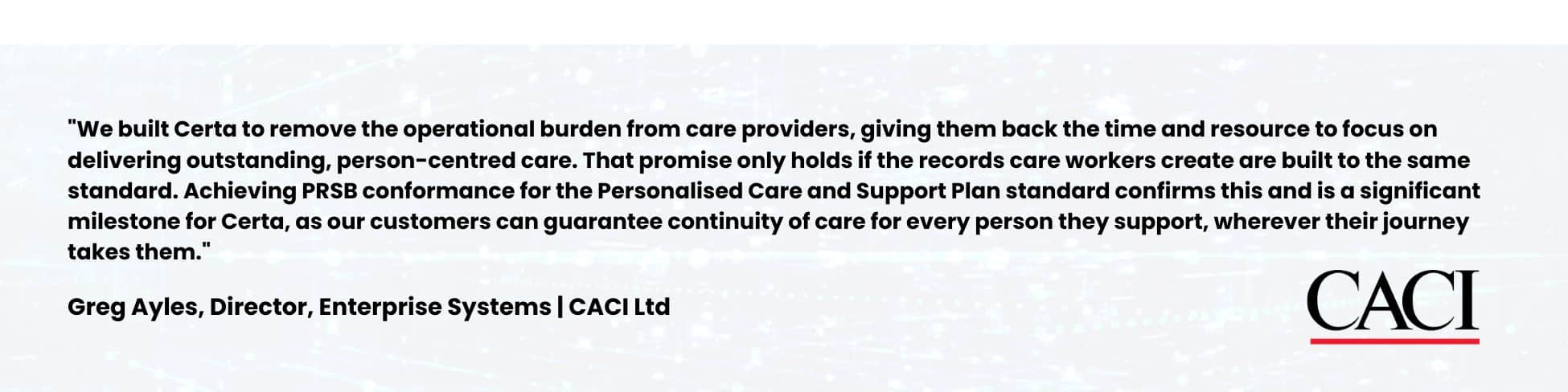
CACI quote

Personalised care and support planning for people with severe mental illness

A review of a sample of current care plans, and the way they have been developed, may be helpful in identifying the priorities for this improvement. The PRSB Implementation Guide provides more detailed explanations about each element of the plan, including advice on how the planning process might be best conducted.
These questions might form a checklist for current plans to be compared with. 

1. Does the plan include an About Me section in which the service user, in their own words, can indicate the information they want to be available about their lives, their values, their interests, and priorities, available for all those who may care for them?
2. Is the approach to developing a care plan patient centred and engaging, allowing plans to be based on patient priorities goals, and aspirations, along with the actions they plan to take and the support that they will receive?
3. Is there space for a “formulation” to be recorded in which the person receiving care and the professionals who provide it, share and record the personal meaning and the origins of the person’s difficulties?
4. Are relevant procedures and therapies recorded?
5. Where relevant, are one or more contingency plans included for anticipatable disruptions, exacerbations, or deterioration, and do they include advice on what to do and points of contact for those called upon to respond?
6. Where relevant are additional supporting plans incorporated, (an example being an “educational and health plan” for someone with a neurodevelopment disorder)
7. Is a version of the plan available to a service user (if they wish to have it) in a form and format that they can understand and find to be of value?
8. How is a version of the plan available to the GP and other key parts of the health and care system?

Work conducted by PRSB and partners recently has looked specifically at the suitability of this approach to the development and documentation of care and support plans for people with Severe Mental Illness. This resulted in an updated version of the standard (v1.4), for use by any service and for any group of service users, but with some modifications to ensure that it meets the needs of this community. The approach to a patient centred process of identifying goals, hopes, and values, and the support needed to achieve them, is fully compatible with and can be conducted using, specific tools in use in mental health, such as DIALOG, DIALOG+, and ReQoL, for example. 

Where analysis indicates the need for improvement in the content and process of personalised care and support planning for patients with Severe Mental Illness, specific improvement projects should be instituted to co-design with service users and their representatives, and the relevant staff groups, new approaches, and documentation that would be of value in delivering improvement. The toolkit includes a range of existing resources that could be used to engage in this improvement work, including signposting to relevant existing approaches informed by patient experience-based design.

Moving to a single holistic plan

A review of a sample of current care plans, and the way they have been developed, may be helpful in identifying the priorities for this improvement. The PRSB Implementation Guide provides A key development, consistent with national policy on support for Personalised Care across all health and care sectors, is the move towards an individual with complex needs having a single, integrated, care plan, rather than a series of plans developed by different parts of the health and social care system in isolation of one another. For a patient with severe mental illness, the related concerns and challenges might form a very prominent part of such an integrated plan; many will also have concurrent health challenges and needs. The intention is that the relevant services work together to plan and wrap support around the patient and their family in an integrated way, rather than as a series of sequential or disconnected encounters in which the service user or their friends and family have to adopt the role of the integrator.

A starting point would be to agree priority groups of service users who may already have more than one care plan because they need care from more than one part of the system of health and social care. This could be initiated by looking at service users registered with some sentinel practices or PCNs. Alternatively, the approach might focus initially on people with defined co-morbidity or risk that entails collaborative care with agencies beyond specialist mental health services.

The focus here is on the process of care planning and agreement on what should be shared, rather than solely on the technology used;

1. What is the process to agree which professional will initiate care planning and act as the “lead point of contact” for the service user?
2. Will initial plans be agreed with the service user in joint consultations or sequentially? Where and how will they be conducted?
3. What will be the process to agree the elements of the plans which should be available to professionals and potential authorised users beyond the immediate care teams, (A&E services, Ambulance Services, Social services, etc.) with the service user’s consent?
4. How will elements of the plan be updated following consultations in a way which is proportionate, to allow contact and progress notes to be maintained by the service conducting the consultation, whilst avoiding unnecessary work for partners in care if there is no significant change to the personalised care and support plan?
5. What are the implications for workload, logistics, and administration arising out of these decisions?

The answers to these questions and others will best be elicited through focused joint working, grounded in real, or at least realistic examples. This will entail process mapping, and co-design with a range of professionals, service users, and families. Resources from the toolkit and outputs from the Simulation element of this project will be valuable. Some organisations would adopt an approach such as a Rapid Process Improvement Workshop, planned over several weeks and conducted over a number of sequential days, to develop prototype ways of working that could be tested in the field.